Skip to content
Struggling to tell Chantilly from Guipure lace? You’re not alone. Many buyers make costly mistakes when sourcing wholesale lace fabric.
The key to identifying lace types lies in examining three critical elements: the ground mesh structure, yarn composition, and motif definition. Start with the base fabric, then assess weight and hand-feel before judging the pattern design.

After two decades at Marry Lace, I’ve seen countless buyers struggle with lace identification. The consequences go beyond simple misunderstandings. When you choose the wrong lace type, your final garment suffers. Let me share the professional methods we use to train our wholesale clients.
What makes Chantilly lace different from other types?
Can’t spot authentic Chantilly among similar-looking alternatives? This classic French style has specific traits that separate quality from imitation.
True Chantilly lace features a fine hexagonal mesh ground with delicate floral motifs outlined in thicker thread. The pattern creates subtle shadowing effects through varying thread densities and strategic open spaces.

The identification process starts with the base structure. Real Chantilly uses a six-sided mesh that forms the foundation. This isn’t random – the hexagonal pattern provides optimal strength while maintaining flexibility. When I examine samples in our design process, I always check this mesh first.
Key Technical Characteristics
The thread weight varies throughout the design. Outlines use heavier thread, typically 120/2 denier, while fill areas use lighter weights around 75/2 denier. This creates natural depth without adding bulk.
Weight specifications:
- Ground mesh: 15-25 gsm
- Complete fabric: 45-65 gsm
- Thread composition: 100% polyamide or cotton blend
The motif edges should feel crisp under your fingertips. Poor quality Chantilly1 has fuzzy or undefined pattern boundaries. Our luxury bridal collection maintains razor-sharp definition through controlled tension during production.
Color behavior also reveals authenticity. Genuine Chantilly1 accepts dye evenly across all thread weights. Cheaper versions show uneven color absorption between the mesh and motifs. This creates a patchy appearance that ruins the fabric’s elegant uniformity.
How can you identify quality in embroidered lace fabrics?
Quality embroidered lace requires more than visual inspection. The manufacturing process directly impacts performance in finished garments.
High-quality embroidered lace shows consistent stitch density, secure thread anchoring, and dimensional stability. Check for uniform tension across the entire fabric width and examine reverse side construction quality.

Thread anchoring separates professional-grade from mass-market embroidered lace. I train our quality team to examine the fabric reverse. Quality embroidery shows neat, trimmed thread ends. Poor quality leaves loose threads that create weak points and potential unraveling.
Professional Assessment Methods
Density Testing: Count stitches per square centimeter. Quality embroidered lace maintains 800-1200 stitches per cm² in filled areas. Lower density creates thin, weak sections that tear during garment construction.
Stretch Recovery2: Pull the fabric gently in both directions. Quality pieces return to original dimensions within 2-3 seconds. Poor recovery indicates unstable ground fabric or inadequate stabilization during embroidery.
Color Fastness3: Professional buyers should request colorfastness certificates. Our embroidered border designs pass standard washing and light exposure tests because we use colorfast threads throughout production.
The stabilizer choice impacts final quality significantly. Water-soluble stabilizers leave the fabric softer but require complete removal. Heat-away stabilizers work faster but can damage delicate threads if overheated. We select stabilizer type based on thread composition and intended garment use.
Border alignment reveals manufacturing precision. Quality embroidered lace shows perfect pattern registration across the full width. Misaligned borders indicate poor machine calibration or rushed production schedules.
What are the key features of 3D floral lace?
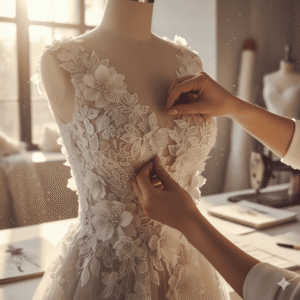
Three-dimensional floral elements transform flat lace into sculptural textile art. Identifying quality requires understanding construction methods and dimensional stability.
Quality 3D floral lace uses layered construction with secure base attachment. Petals and leaves should maintain shape without stiffening agents, while dimensional elements resist flattening during normal handling.

Construction method determines durability and appearance. Our 3D floral embellishments use multi-layer embroidery rather than applied elements. This approach creates stronger attachment points and more natural dimensional flow.
Technical Construction Analysis
Layer Integration: Quality 3D effects integrate multiple embroidery layers during production. Each petal builds on the previous layer, creating natural dimension. Cheaper versions add pre-made elements that can detach during use.
Base Fabric Compatibility4: The ground fabric must support dimensional elements without puckering. We use stabilized tulle or mesh with calculated give. Rigid bases crack under stress while overly flexible grounds allow sagging.
Dimensional Retention5: Test by gently compressing raised elements. Quality flowers spring back immediately. Poor construction stays flattened or feels artificially stiff from excessive stabilization.
Thread selection affects both appearance and performance. We use graduated thread weights – heavier for structural elements, lighter for delicate details. This creates natural-looking variations in opacity and texture.
Attachment Security Assessment:
- Pull test individual petals gently
- Check for loose thread ends around dimensional elements
- Examine reverse side for adequate anchoring
- Verify even spacing across pattern repeats
Color depth varies naturally in quality 3D florals. Machine settings create subtle shading through thread density variations. Flat, uniform coloring indicates simplified construction that lacks professional depth and realism.
How do you distinguish genuine French lace from imitations?
French lace carries premium pricing, making accurate identification crucial for wholesale buyers. Manufacturing origin affects both quality and market positioning.
Authentic French lace shows superior yarn quality, precise pattern registration, and distinctive construction techniques passed down through generations. Check for consistent thread tension and traditional motif proportions that reflect regional specialties.

Regional patterns tell the story. Calais lace differs from Lyon production in both technique and aesthetic. True French manufacturers maintain traditional pattern libraries that reflect centuries of development. Modern imitations often blend regional styles incorrectly.
Authentication Techniques
Yarn Analysis: French lace uses superior yarn preparation. Threads show consistent twist and minimal fuzzing even under magnification. The spinning quality directly affects final fabric hand and drape characteristics.
Pattern Authenticity: Traditional French motifs follow historical proportions. Rose patterns maintain specific petal-to-leaf ratios. Geometric designs use classical mathematical relationships. Variations from these standards suggest non-French origin.
Manufacturing Signatures: Each French lace region developed distinctive construction methods. Chantilly from Calais shows different mesh characteristics than similar styles from other regions. These subtle differences require experience to identify accurately.
Documentation Requirements: Legitimate French lace suppliers provide origin certificates and manufacturing details. Request documentation that traces production from yarn source through final finishing processes.
Our experience working with European mills since 2007 helps us distinguish authentic pieces. We maintain sample libraries showing regional variations and construction differences. This reference system helps clients make informed sourcing decisions for their wholesale lace fabric needs.
Quality French lace undergoes traditional finishing processes that affect hand-feel and appearance. Steam blocking, careful pressing, and controlled drying create the characteristic drape and texture. Rush finishing destroys these qualities and reveals non-traditional production methods.
Conclusion
Identifying lace types requires systematic examination of construction details, yarn quality, and manufacturing precision rather than pattern recognition alone.
-
Explore this link to understand the unique qualities of genuine Chantilly lace and how to identify it. ↩ ↩
-
Testing stretch recovery is essential for fabric durability. This resource provides detailed methods to ensure your fabrics meet quality standards. ↩
-
Understanding color fastness is crucial for maintaining the quality and longevity of embroidered fabrics. Explore this link for expert insights. ↩
-
Exploring Base Fabric Compatibility can help you choose the right materials for optimal embroidery results, preventing common issues. ↩
-
Understanding Dimensional Retention is crucial for ensuring quality in embroidery, enhancing both aesthetics and durability. ↩